Pantai Matahari Terbit

Matahari Terbit Beach Offers Comfortable Sunrise Viewing Facilities

Matahari Terbit Beach, located in the Sanur area of Bali, is a popular destination for tourists and locals alike. The beach offers stunning views of the sunrise, making it a must-visit location for those who want to experience the beauty of Bali. The beach has comfortable seating areas and a spacious parking area for private vehicles, making it an easy and convenient location to visit.

In addition to the comfortable seating areas, tourists can enjoy gazebos, toilets, and souvenir kiosks. Accommodation is also available, so visitors can stay overnight and enjoy the beach for longer periods of time. Boat rentals are also available, allowing visitors to explore the coastline and nearby islands.

The beach is also ideal for photo hunting and pre-wedding photo shoots. With its stunning views and comfortable facilities, it's the perfect location for couples looking to capture beautiful memories of their special day.

For those who love to stay active, there are jogging tracks available for a morning run along the beach. The beach is a great place to enjoy a peaceful walk, take in the fresh sea air, and soak up the stunning scenery.

Overall, Matahari Terbit Beach is a must-visit location for anyone who wants to experience the beauty of Bali. With its comfortable facilities, stunning views, and wide range of activities, there is something for everyone to enjoy. Whether you are looking for a relaxing day at the beach or an adventure-filled experience exploring the nearby islands, Matahari Terbit Beach has it all.

Pantai Sanur

Sanur Beach is one of Bali's most captivating beaches, renowned for its natural beauty and rich cultural history. This beach has been popular for centuries, and even ancient kings have recognized its allure. In fact, Sanur Beach appears in the King Kesari Warmadewa's Inscription, which dates back to 917 AD.

Located on the southeastern coast of Bali, Sanur Beach is known for its pristine white sands and crystal-clear waters. The beach stretches for several kilometers and is an ideal spot for swimming, sunbathing, and water sports. Sanur Beach also offers spectacular views of Bali's eastern coastline, with the majestic Mount Agung looming in the distance.

The beach is not just a popular tourist destination but also an important historical site. The King Kesari Warmadewa's Inscription is evidence of Sanur Beach's importance in Bali's past. This inscription is the oldest known artifact of Balinese history, and it tells the story of the first known king of Bali, who ruled in the 10th century.

According to the inscription, King Kesari Warmadewa was a wise and just ruler who lived in Singhadwala, which is now known as Gianyar. He was known for his love of the arts and his patronage of scholars and artists. He recognized the beauty of Sanur Beach and built a temple there, which still stands to this day.

The temple, called Pura Blanjong, is located near the southern end of the beach. It is a small, simple structure, but it is an important cultural landmark. The temple houses ancient stone inscriptions, including the King Kesari Warmadewa's Inscription, which are important historical artifacts of Bali's past.

In addition to the temple, Sanur Beach is home to several other cultural attractions. The Bali Beach Golf Course is located just north of the beach, and it is one of Bali's premier golf courses. The Le Mayeur Museum, located near the northern end of the beach, is a museum dedicated to the work of Belgian painter Adrien-Jean Le Mayeur, who lived in Bali for many years.

Sanur Beach is also a popular destination for water sports enthusiasts. The calm waters of the beach are perfect for swimming, snorkeling, and scuba diving. The beach is also a popular spot for windsurfing, kite surfing, and parasailing.

Overall, Sanur Beach is a must-visit destination for anyone traveling to Bali. Its natural beauty and cultural significance make it one of the most riveting beaches in Bali.

Pura Dalem Kedewatan

Pura Dalem Kadewatan located at Sanur Village was one of the cultural heritage of Denpasar in Sanur. This Pura was built in XV-XX Masehi and before moved to Sanur, this Pura was located in Tangtu, at the edge of Ayung River.

When Tangtu was heavily flooded by the river, all the ceremony was postponed. That’s the moment when the locals decided to moved this Pura to the south, to Tegal Asah, where the land countour has stages and they found a higher place and shine. The place inspired the name Sanur, it came from the word Sa = means one single and Nur = means holy light.

The rituals held in this Pura is using the spiritual timing on Tilem day to triwara kajeng, often named as Tilem Kajeng. Tilem was a prabhawa from Sang Hyang Siva that also had a form as Sang Hyang Yamadipati (The God of the dead) who had the vanishing power.

The dances of Sang Hyang will be performed on the piodalan day.  One of the dance is Sang Hyang Jaran. This dance is very sacred and stopped performed in 1938 and then finally resume on 2016.


This dance showed a horse played and showered with fire with two Pratima in red and white. This sacred dance will feel scary when the dancer as Sang Hyang Jaran playing with a real fire in the middle of the pura and all the songs played in sacred way.


One day after piodalan Tilem Kajeng, the people will do the gebogan offerings along the village. This gebogan will be carried by the womens wearing white and yellow kebaya to praise God for all the blessings. This ceremony called Mepeed.

Pura Dalem Penataran

Pura Dalem Penataran located close to Pura Siwa Dampati. This Pura was built around XVIII-XIX. In Its Gedong Dalem there are sculpture mentioned the year 1793 or 1871 Masehi. Most part of this building which is Gedong Dalem, Palinggih Sumur Suci, Palinggih Hyang Api (Lebuh Geni), Paduraksa Candi Kurung (Kori Agung) and other statues was made from red bricks and rockstone.

Dampati Shiva Temple

Experts predicted that Pura Siwa Dampati was made within XVIII-XIX century. This pura still in good shape with red bricks and related to Pura Dalem Penataran.

Dampati means The Meeting. In Regweda writings, Dampati also refer to a unity between a man and a woman that cannot be separated. This meanings was believed as a manifests of the unity of Siwa and Sakti, the Durga Goddes in Pura Dalem Penataran.

This complex consists of

Gedong Siwa Dampati, Paduraksa Candi Kurung (Kori Agung), dwarapala statue, and a priest statue (Brahmana).

Segara Temple

Experts predicted that Pura Siwa Dampati was made within XVIII-XIX century. This pura still in good shape with red bricks and related to Pura Dalem Penataran.

Dampati means The Meeting. In Regweda writings, Dampati also refer to a unity between a man and a woman that cannot be separated. This meanings was believed as a manifests of the unity of Siwa and Sakti, the Durga Goddes in Pura Dalem Penataran.

This complex consists of

Gedong Siwa Dampati, Paduraksa Candi Kurung (Kori Agung), dwarapala statue, and a priest statue (Brahmana).

Dalem Jumeneng Temple

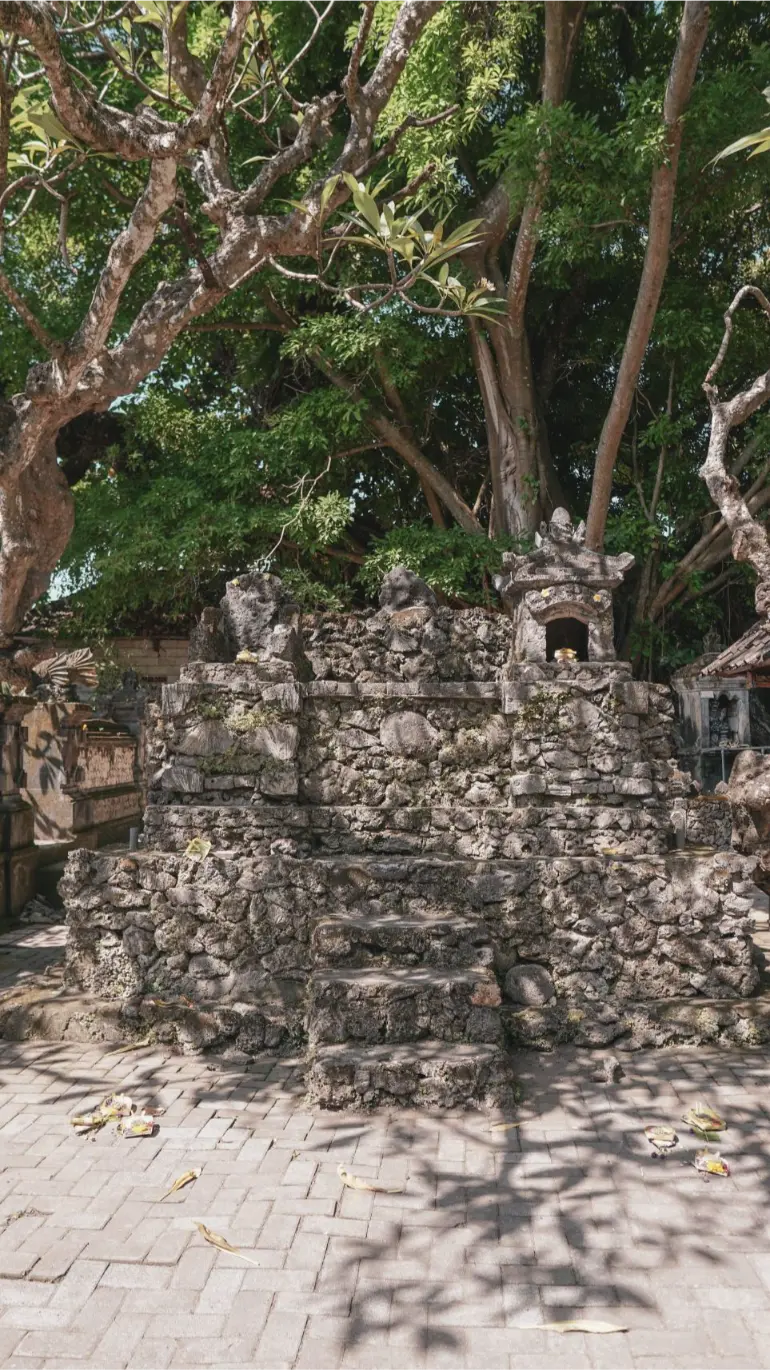
Still within the beachside of Segara Ayu, there is Pura Segara Ayu. Since there is no authentic history about this Pura, but the structure is very similar with Pura Dalem Jumeneng with layers of Gamping stones. Therefore the experts made an assumption that this Pura was built in Megaliticum age.

The fishermen and all the village people surround that area use this Pura to give offerings, celebrations, and praying. Mostly, they use it to ask a blessing for fishing.

In Balinese, Segara means the beach or seaside, and also known as the territory of Wisnu, the Hindu God. They celebrate piodalan (the birthdays of the pura) on Purnama Kedasa (Purnamaning Sasih Kedasa)

There are 3 spot to place offerings; Palinggih Gunung Agung, Palinggih Gunung Batur, and Palinggih Dalem Segara. All the offerings send for the goodness of the nature, and the mountain. Later in the days, the people surround the area made 3 statues to completed the architectural design; dragon, turtle, and elephant fish statues.

Palinggih Bathara Bayu

is the place to praise Bayu, the God of the wind for Hindu Bali

Penyawangan Ratu Mas Melanting

Queen Melanting and Queen Jilih Lambih was the goddess for fertility, life goodness, and prosperity.

Linggih Ratu Manik Kembar

Made from gamping stone layers with three throne chambers. The thrones are made from stones and believed as the place for the Gods to sit and heard prayers.

Tahta Batu          

A throne with a big seat back. Was made from a single gamping stone with a very minimalist sculptures.

Sumur                  

An ancient dwell that brings water. The people used the water from this dwell only for special prayers and made a wall surround it also with gamping stones.

Menhir                 

It’s a very solid vertical stone used to be a tombstone and also  believed there are spirits inside this.

Kedok Muka        

These masks was made very simple, the simple lines made a siluet of eyes, noses, and mouths.

Baris Cina Dance at Kesumajati Temple Semawang

Baris Cina Dance that held specially in Pura Kesumajati, Semawang, is a very sacred dance and performed only in Piodalan Ceremony of the Pura. This Dance was counted as intangible heritage in October 10th 2018. Unwritten history that told from generations mentioned that this dance was once performed by Ida Ratu Tuan who had tranced and speak with Chinese language, since then, they named this dance as Baris Cina Dance.

The move in this dance similar to Kungfu move, accompanied by Gong Bheri music, the gong is flat and similar to chinese’s musical instruments.

WADON SUSUNAN TEMPLE

According to Pemangku Pura, Jero Mangku Nengah Sudira, this pura has a very closed connection with Pura Dalem Sakenan. This Pura was built as a place to praise Ida Bhatari Istri, the spouse of Ida Bhatara Lanang which place (praised) in Pura Dalem Sakenan.

Temple story

Susunan Wadon Temple

The legend told the story that Ida Bhatari was upset and angry because Ida Bhatara Lanang Dalem Sakenan was taking other women as the second wife. She then didn’t want to see him (Ida Bhatara) again. This is the reason why this two pura  is facing different direction. Pura Dalem Sakenan is facing west, meanwhile Pura Susunan Wadon is facing east.

Other legend told that by the time Dang Hyang Nirartha was finished Pura Dalem Sakenan at Serangan Island, he was heading east and then find another sacred location to build Sthana for Bhatari Durga, then he did his meditation on that place. During his meditation, Bhatari Durga was came and told him to become the King for Bali before he did his Moksha. But Dang hyang Nirartha refused this.

Bhatari Durga gave him other alternative, he had to head to North West to reach his Moksha, to the sthana of Dewa Rudra (Pura uluwatu). Dang Hyang Nirartha built Pura Susunan Wadon with the villain before he leave the place. The word Wadon means “women” and it also means that place is a sacred place for Bhatari Durga (Aryantari, 2010:41-43)


Pura Susunan Wadon is listed as part of Pura Dang Kahyangan in Bali, there is Piodalan Ceremony specially held for this pura every 210 days, on Redite Umanis, Wuku Kuningan. Dang Kahyangan was used as a place to praise and send all the offerings for dang guru (the holy and sacred guru) Mpu Kuturan and Danghyang Nirartha (Ida Pedanda Sakti Wawu Rawuh). Pura Susunan Wadon also cathegorized as pura Kahyangan Jagat Bali

Temples and statues built in the XV – XVI Century period

1. The temple of Gedong Ida Bhatari Lingsir Dalem Susunan Wadon

Height               : – cm

Length               : 367 cm

Width                 : 329 cm

Limestone

2. Paduraksa Candi Bentar

Limestone

Located in the middle of wall that connecting inside building with the middle one.

3. Nandi I Statue

Height              : 50 cm

Width                : 36 cm

Length              : 59 cm     

Limestone

Located at the south of prasada. The Hindu Balinese iconography mentioned this cow sheep statue as Siva, local people call it Kebo Dongol.

4. Nandi II Statue

Height            : 50 cm

Width              : 36 cm

Length             : 70 cm     

Limestone

Located at the north of Prasada

5. Dwarapala Statue I

Height             : 102 cm

Width              : 37 cm

Length            : 38 cm

Limestone

Located at the south of Prasada

6. Dwarapala II Statue

Height               : 101 cm

Width                : 31 cm

Thickness         : 35 cm   

Limestone

Located at the north of Prasada

7. Dwarapala Bhatari I Statue

Height               : 122 cm

Width                 : 53 cm

Thickness          : 49 cm   

Limestone

Located at the west side of Candi Bentar. They call it as Dwarapala Bhatari, the statue that guard the entrance with the siluet of a very scary women

8. Dwarapala Bhatari II Statue

Height                 : 122 cm

Width                  :   48 cm

Thickness           :   49 cm   

Limestone

This statue is located at the front east of Candi Bentar.

9. Panji Statue I

Height                     : 69 cm

Width                      : 33 cm

Thickness               : 29 cm     

Limestone

This statue wearing a very unique headpiece, shaped like a roll called gelungan pepanjian or keklopingan. In Balinese ancient dance (dramatari gambuh), panji used to play the role as a king.


10. Panji Statue II

Tinggi                : 72 cm

Lebar                 : 34 cm

Tebal                  : 32 cm                           

Limestone

11. Kadean-kadean Statue

Height              : 81 cm

Width                : 30 cm

Thickness         : 32 cm                 

Limestone

This statue had gegelungan jejempongan as the headpiece. Kadean-kadean is playing the role as ministers in dramatari Gambuh Bali.

12. Twalen Statue

Height                 : 73 cm

Width                  : 40 cm

Thickness           : 34 cm                

Limestone

This statue playing a role as the wisemen for the king

13. Mredah Statue

Height               : 76 cm

Width                :  29 cm

Thickness         : 30 cm             

Limestone

This is also playing a role as the wisemen. She is the partner for Twalen, her father.


Bugis Ancient Tomb

Details of Bugis Ancient Tomb Buildings

The tomb was located at the south of Bugis Village. All the tombstones written in Arabic showed the names, prayers, and the years they had been burried. The oldest tombstone is the one which made on 1269 Hijriah or 1833, some of then ranged untill 1335 Hijriah or 1916.

The aculturation between two cultures, Bugis and Balinese, is really shown in these tombstones. Balinese patterns on the sculptures, such as pepatran, kekarangan with simbar-simbar, padma, patra mesir, patra sari, patra cina is combined beautifully with Bugis sculptures styles such as tiny leaves, lontara letters and arabic letters. Moh ali Fadillah (1986) in his research mentioned that there are 178 tombstones in this complex.

Puak Metowa Tomb or Puak Gede

This tomb is bigger than the rest, the people told that this is the tomb of the important person in their community, Puak Metowa or Puak Gede. The title was fiven from King of Badung, Cokorda Pemecutan III, as an honor for him.

The tomb has a special shape with layers of square concretes smaller to the top. This type of tomb is similar to the one that built for the kings of watan lamaru or tallo, in south sulawesi.