The Charm of Badung Traditional Market Murals: Transforming the Traditional Market with Modern Art Touches

For art enthusiasts and social media aficionados, this spot is a must-visit: the Mural Market at Pasar Badung. Don’t think of it as just a place for buyers and sellers. Pasar Badung, the largest market in Bali, is adorned with vibrant murals scattered across its walls. These murals were created back in 2019, following a renovation due to a fire. You can find them everywhere—from the entrance gates, elevators, and kiosks, to waiting areas, and even in the bathrooms. 

If you’re not satisfied with the smaller artworks, head over to the east side of the market. Here, you'll find a colossal mural painted on a 308-square-meter wall canvas. The visuals are not only captivating but also carry messages encouraging people to take pride in shopping and trading at traditional markets, reimagined in a modern setting like Pasar Badung.

These creative embellishments aim to position Pasar Badung as an inspiration for traditional markets across Bali and even Indonesia. The murals were crafted by 30 young artists from the Bali School of Design (STD), in an effort to change the perception that traditional markets are just a place for transactions. At Pasar Badung, tourists are welcomed as well.

By the way, you can visit and capture the murals at any time, as the market is open 24 hours a day, except on the holy day of Nyepi. Being the largest market in Bali, Pasar Badung serves as the starting point for various goods distributed throughout the island. So, whether you're an early bird or a night owl, Pasar Badung's art awaits!

Kumbasari Art Market: An Affordable Hub for Balinese Art and Souvenirs

Art enthusiasts must know about Kumbasari Art Market. Long before the famous souvenir centers emerged, this market was a must-visit destination for tourists seeking artistic souvenirs for their family and friends. To this day, Kumbasari Art Market remains vibrant and worth visiting.

It is located on the west side of the Badung Traditional Market, precisely in the Gajah Mada Heritage Area. The market is separated from Badung Market by the "Korea" River, Tukad Badung. Having undergone three phases of revitalization, this market is referred to as the only art market in Denpasar. Kumbasari Market was established in 1977, experienced a fire in 2000, and was renovated, reopening in 2001.

The building is quite spacious, covering an area of 6,230 square meters. It consists of five floors, with four floors designated for art product vendors. The remaining floor is allocated for vendors selling basic necessities and religious ceremony supplies.

On the second floor of Kumbasari Art Market, various types of clothing are sold, including traditional Balinese attire such as udeng, kain, and destar. Bed covers, beach sarongs, and various woven crafts from Bali are also available. The third floor features an array of paintings, sculptures, and Balinese ornaments like carvings, shoes, sandals, and women's bags. On the fourth floor, you can find various handicrafts and souvenirs made from shells, paper, and some crafts from outside Bali.

Not many people realize how vital this market is, as it serves as a wholesale center supplying products to art vendors in Sanur, Kuta, Canggu, and Ubud. Most locals are unaware of this because the majority of vendors here source directly from artisans in remote areas.

The range of crafts sold at Kumbasari Art Market is diverse, including brasswork, ceramics, glass, rattan, and wooden crafts. An important piece of information that tourists often overlook is the pricing. Don’t be surprised when shopping here; prices are significantly lower compared to souvenir centers. Since the products are sold wholesale, they are naturally much cheaper.

For those who know about these affordable prices, it’s worth a visit. Additionally, prices are negotiable, as is common in traditional markets. The location is also very accessible.

narasi-pembangunan-kampung-kuliner-serangan-docx-google-docs

Pembangunan Kampung Kuliner Serangan

Desa Serangan di Denpasar, Bali, yang dikenal dengan keindahan alam dan warisan budayanya, kini sedang membangun proyek unggulan yaitu Pembangunan Kampung Kuliner Seafood Serangan, pemerintah berupaya menciptakan destinasi wisata kuliner baru yang terletak di Jl. Tukad Pekaseh No.2, Serangan, Denpasar Selatan. Proyek ini berfokus pada penyediaan fasilitas kuliner berbasis makanan laut yang khas dengan nuansa lokal.
Proyek ini berlokasi di lapangan I Wayan Bulit, Serangan, yang dibangun di lahan dengan mempunyai luas lapangan = 21,190 m2 dan luas lahan BTID = 2,420 m2. Didukung penuh oleh Dinas Pariwisata Kota Denpasar sebagai pemberi tugas. Dengan dibantu Dana Alokasi Khusus (DAK) Fisik 2024 yang disalurkan oleh Kementerian Pariwisata dan Ekonomi Kreatif Republik Indonesia, pembangunan ini akan mengoptimalkan fasilitas fisik untuk mendukung keberlangsungan wisata kuliner di Serangan.
Proyek ini melibatkan beberapa pihak ahli, termasuk PT. TATA RENCANA HIJAU sebagai konsultan perencana dan CV. BINA BWANA WISESA sebagai konsultan pengawas, dilaksanakan oleh kontraktor pelaksana PT. MEGAH TAMA PERKASA dengan nilai kontrak sebesar Rp 5.204.246.761,00. Pembangunan ini direncanakan berlangsung selama 180 hari kalender dari 14 Juni hingga 10 Desember 2024, di mana setiap tahapannya diawasi dengan ketat untuk memastikan hasil yang optimal.

Pengembangan Kampung Kuliner Serangan merupakan bagian dari tiga program unggulan yang dirancang untuk meningkatkan potensi Desa Serangan secara menyeluruh. Program pertama adalah penyiapan Sumber Daya Manusia (SDM) dan kelembagaan desa, di mana pemerintah bekerja sama dengan berbagai pihak untuk memberikan pelatihan kepada masyarakat lokal agar mampu mengelola potensi wisata secara efektif, sekaligus memperkuat kelembagaan desa agar masyarakat terlibat aktif dalam pengelolaan kampung kuliner. Program kedua adalah memformulasikan branding, paket kegiatan, dan promosi desa wisata, yang berfokus pada pengembangan branding Desa Serangan sebagai destinasi kuliner yang khas, didukung oleh promosi intensif melalui media sosial dan kampanye pemasaran, serta kolaborasi dengan travel influencer. Selain itu, paket wisata kuliner yang dirancang akan memberikan pengalaman lengkap yang mencakup wisata kuliner, budaya, dan alam. Program ketiga adalah 55 rencana aksi yang mencakup berbagai aspek pengembangan desa, seperti peningkatan infrastruktur, pelatihan SDM, dan pengembangan produk wisata, yang semuanya bertujuan untuk memaksimalkan potensi wisata dan ekonomi Desa Serangan. Pembangunan Kampung Kuliner Seafood Serangan mencakup berbagai fasilitas penting, seperti pembangunan 14 bangunan dan 28 kios kuliner yang akan menjadi tempat bagi pedagang lokal untuk menawarkan hidangan seafood serta makanan khas Bali. Plaza Kuliner dirancang sebagai pusat kegiatan sosial dan rekreasi, di mana pengunjung dapat menikmati suasana santai sambil mencicipi berbagai hidangan. Selain itu, fasilitas toilet umum juga dibangun untuk memastikan kenyamanan pengunjung, dengan kebersihan dan standar fasilitas yang baik. Sebanyak 16 unit gazebo disediakan di sekitar area kuliner untuk tempat bersantai yang nyaman, didukung oleh area parkir yang memudahkan akses pengunjung. Infrastruktur pendukung seperti rumah STP dan resapan, serta tandon air bawah tanah (Ground Water Tank), berperan penting dalam menjaga pengelolaan air dan kebersihan lingkungan. Sebagai tambahan, 64 unit bangku taman tersebar di area plaza dan taman untuk menambah kenyamanan pengunjung selama menikmati suasana kuliner di Serangan.

Proyek Kampung Kuliner Seafood Serangan memanfaatkan dana DAK Fisik 2024 dengan total anggaran sebesar Rp 5.204.246.761,00 yang mencakup berbagai aspek penting dalam pembangunan infrastruktur kampung kuliner. Dana ini digunakan untuk penerapan Sistem Manajemen Keselamatan dan Kesehatan Kerja (SMKK) sebesar Rp 18.640.000,00, pekerjaan persiapan senilai Rp 436.623,97, serta pembangunan inti berupa 14 bangunan dan 28 kios kuliner dengan anggaran Rp 1.637.899.041,95, di mana kios-kios tersebut akan diisi oleh pedagang yang menawarkan kuliner khas Bali dan Serangan. Selain itu, pembangunan plaza kuliner sebesar Rp 1.767.823.405,96, toilet senilai Rp 443.690.627,97, serta 16 unit gazebo dengan anggaran Rp 399.699.204,80 disiapkan untuk kenyamanan pengunjung. Fasilitas pendukung lainnya termasuk area parkir A sebesar Rp 106.424.186,73, rumah STP dan resapan sebesar Rp 72.450.829,52, Ground Water Tank (tandon air bawah tanah) senilai Rp 63.236.431,05, serta 64 unit bangku taman dengan total Rp 178.210.244,42. 

Namun, proyek ini menghadapi keterbatasan anggaran sehingga pemerintah memanfaatkan dana CSR sebesar Rp 2.599.991.078,00 dari perusahaan swasta untuk menyelesaikan beberapa pekerjaan penting. Dana CSR tersebut digunakan untuk penerapan SMKK Rp 25.643.650,00, pekerjaan persiapan Rp 552.056,28, pembangunan pergola kayu Rp 468.000.000,00, softscape (penataan area hijau) Rp 11.900.000,00, meja taman Rp 54.000.000,00, meja gazebo Rp 6.400.000,00, service area Rp 238.000.000,00, peningkatan daya listrik Rp 139.521.228,00, pengadaan alat kios kuliner Rp 1.124.676.000,00, pembangunan bak sampah Rp 145.345.492,55, serta signage sebesar Rp 128.295.877,68 untuk membantu pengunjung menemukan area penting di kampung kuliner.


Showcasing Bali's Heritage: The Marvel of Barong Dance and Keris by Sekaa Barong and Keris Sari

This is one of the most commonly found cultural performances in Denpasar City—the Barong and Keris Dance. One of the prominent groups involved is Sekaa Barong and Keris Sari, a cultural tourism group in Bali, Indonesia, dedicated to preserving and showcasing traditional Balinese arts and culture. The group is committed to promoting the beauty and significance of Bali’s cultural heritage through their performances and activities.

Sekaa Barong and Keris Sari specializes in two important cultural elements: the Barong dance and the Keris dance. The Barong dance is a traditional Balinese dance that depicts the eternal battle between good and evil. It features a large mythical creature called Barong, representing good, and a demon-like creature called Rangda, representing evil. The dance is accompanied by vibrant music and colorful costumes, captivating the audience with its energetic movements and dramatic storyline.

The Keris dance, on the other hand, showcases the traditional Indonesian weapon known as the keris. The dance incorporates fluid and graceful movements, symbolizing the beauty and precision of the keris. It is often performed as a solo dance, accompanied by traditional gamelan music.

Sekaa Barong and Keris Sari actively participate in cultural tourism activities, including performances at various venues and events. They contribute to the promotion of Balinese arts and culture by showcasing their skills and talent to both local and international audiences. Their performances often attract tourists who are interested in experiencing the rich cultural traditions of Bali.

In addition to their performances, Sekaa Barong and Keris Sari also engage in educational activities. They offer workshops and training sessions to teach the younger generation about the traditional dances and the cultural significance behind them. By passing down their knowledge and skills, they ensure the continuity of Balinese cultural heritage for future generations.

Furthermore, Sekaa Barong and Keris Sari actively collaborate with other cultural groups and organizations to promote cultural exchange and cooperation. They participate in festivals, exhibitions, and cultural events both locally and internationally, representing the vibrant artistic traditions of Bali.

Through their dedication and commitment, Sekaa Barong and Keris Sari contribute to the preservation and promotion of Balinese cultural tourism. They play a significant role in showcasing the rich artistic heritage of Bali, attracting visitors from all around the world who are eager to witness the beauty and uniqueness of Balinese arts and culture.

Tracing Historical Footsteps at Puri Pemecutan: A Legacy of Bali's Struggle Against Colonizers

Although Denpasar is known as a modern city in Bali, traces of historical struggles remain for visitors to discover in the island’s capital. One such place is Puri Pemecutan Denpasar, a royal palace that serves as a reminder of the significant influence of ancient kingdoms on Bali’s development.

Located on Jalan Tamrin, Puri Pemecutan stands proudly on a 4.2-hectare estate. This area does not include the expansions made to the west, north, east, and south at Puri Tanjung Pemecutan, which serves as the residence of royal descendants. To the west of the palace, there is an armory with rifles and cannons. On the eastern side are Jero Ukiran and Jero Kanginan, which now form the new Puri Agung Pemecutan.

The palace has also been a symbol of Bali’s resistance against Dutch colonial forces. In 1906, during the Puputan war, the palace was set ablaze in a dramatic standoff against the Dutch. Today, the palace is in excellent condition, retaining its distinct Balinese ornaments that cover nearly every corner of the building.

The architecture of Puri Pemecutan is still reminiscent of its original form before the fire, featuring traditional elements. The front courtyard, known as Jaba Jeroning Cerangcang, greets visitors, while the Jaba Bale Gong, located in the western corner, serves as a storage space for ancient musical instruments like gamelan. There are also kitchens and rooms that once housed royal family members. The bale kulkul, a watchtower on the southern side of the palace, silently witnessed the Puputan war and remains intact, the only structure that survived the flames.

Visiting Puri Pemecutan feels like stepping back into a pivotal chapter of Bali’s history, reflecting on the island's resistance against Dutch occupation. If you're lucky, you might not only catch a glimpse of what the royal palace looked like in the past but also witness a film crew on-site, as the palace is occasionally used for national movie productions. So, what are you waiting for? Plan your visit to Puri Pemecutan and experience a piece of Balinese history firsthand.

Lumintang City Park: An Integrated Recreation Destination in the Heart of Denpasar

Here is the favorite city park for the people of Denpasar. It is located on Jalan Gatot Subroto Tengah. This city park offers complete facilities for families with various purposes in the capital of Bali. For those who aren’t familiar with this park, let’s take a look at the available facilities at Lapangan Kota Lumintang.

Taman Kota Lumintang is not just equipped with sports facilities; it has transformed into a beautiful city park that serves as a new choice for recreation and education for families. The park is divided into several themed areas, such as a traffic park, a senior park, a fitness park, a bird park, a digital park, and a children's playground. All of these areas provide recreational opportunities for relaxation in the city. The park is bisected by Jalan Gatot Subroto Tengah.

On the southern side of the road, there is a traffic park that has been inaugurated with traffic signs and facilities to educate children about road safety. One of the newest facilities in this southern area is an internationally recognized skatepark. Moving to the northern side of Lapangan Lumintang, there is a digital park that provides easy access to information technology through comfortable internet services, complete with seating and tables. This area is also equipped with CCTV and free Wi-Fi for information access.

There is also a Youth Park, which is often used as a coworking space, a mini food court, for youth entrepreneurship training, live music shows, dance, theater, and creative exhibitions (such as paintings, photographs, and architecture). The Youth Park features its own jogging track, allowing visitors to jog while enjoying the clean and well-maintained Tukad Tagtag river.

The main facility on the northern side is an open area featuring a jogging track. This facility is most frequently used by residents in the early morning, with peak usage in the late afternoon. There is also a senior park, which is often utilized by elderly residents for activities such as aerobics and light exercises like walking.

Additionally, there is a bird park where children can learn about the agility of pigeons while interacting directly by feeding them. For those exercising, various fitness facilities are available at no cost.

One indicator of a city’s livability is having a proper city park. Taman Kota Lumintang certainly meets this criterion.

Pura Dalem Kedewatan

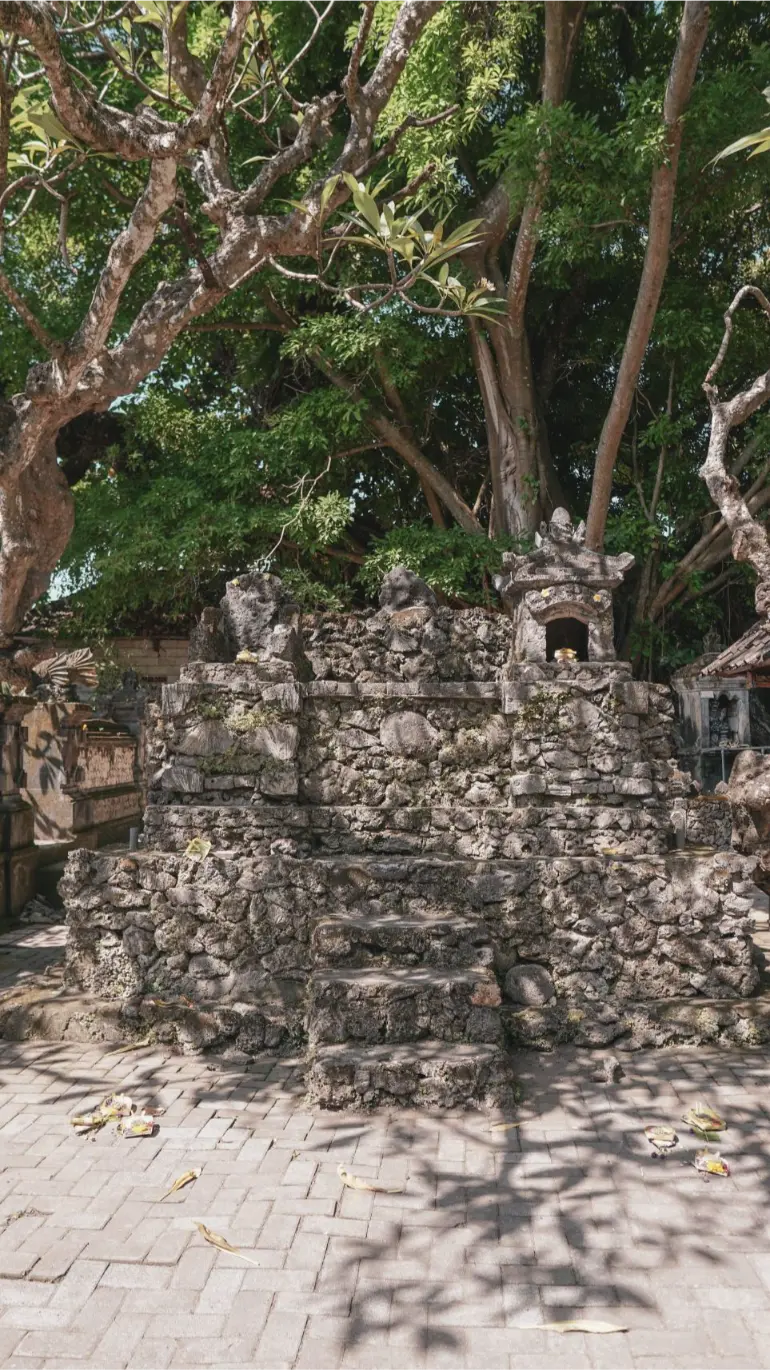
Pura Dalem Kadewatan located at Sanur Village was one of the cultural heritage of Denpasar in Sanur. This Pura was built in XV-XX Masehi and before moved to Sanur, this Pura was located in Tangtu, at the edge of Ayung River.

When Tangtu was heavily flooded by the river, all the ceremony was postponed. That’s the moment when the locals decided to moved this Pura to the south, to Tegal Asah, where the land countour has stages and they found a higher place and shine. The place inspired the name Sanur, it came from the word Sa = means one single and Nur = means holy light.

The rituals held in this Pura is using the spiritual timing on Tilem day to triwara kajeng, often named as Tilem Kajeng. Tilem was a prabhawa from Sang Hyang Siva that also had a form as Sang Hyang Yamadipati (The God of the dead) who had the vanishing power.

The dances of Sang Hyang will be performed on the piodalan day.  One of the dance is Sang Hyang Jaran. This dance is very sacred and stopped performed in 1938 and then finally resume on 2016.


This dance showed a horse played and showered with fire with two Pratima in red and white. This sacred dance will feel scary when the dancer as Sang Hyang Jaran playing with a real fire in the middle of the pura and all the songs played in sacred way.


One day after piodalan Tilem Kajeng, the people will do the gebogan offerings along the village. This gebogan will be carried by the womens wearing white and yellow kebaya to praise God for all the blessings. This ceremony called Mepeed.

Pura Dalem Penataran

Pura Dalem Penataran located close to Pura Siwa Dampati. This Pura was built around XVIII-XIX. In Its Gedong Dalem there are sculpture mentioned the year 1793 or 1871 Masehi. Most part of this building which is Gedong Dalem, Palinggih Sumur Suci, Palinggih Hyang Api (Lebuh Geni), Paduraksa Candi Kurung (Kori Agung) and other statues was made from red bricks and rockstone.

Dampati Shiva Temple

Experts predicted that Pura Siwa Dampati was made within XVIII-XIX century. This pura still in good shape with red bricks and related to Pura Dalem Penataran.

Dampati means The Meeting. In Regweda writings, Dampati also refer to a unity between a man and a woman that cannot be separated. This meanings was believed as a manifests of the unity of Siwa and Sakti, the Durga Goddes in Pura Dalem Penataran.

This complex consists of

Gedong Siwa Dampati, Paduraksa Candi Kurung (Kori Agung), dwarapala statue, and a priest statue (Brahmana).

Segara Temple

Experts predicted that Pura Siwa Dampati was made within XVIII-XIX century. This pura still in good shape with red bricks and related to Pura Dalem Penataran.

Dampati means The Meeting. In Regweda writings, Dampati also refer to a unity between a man and a woman that cannot be separated. This meanings was believed as a manifests of the unity of Siwa and Sakti, the Durga Goddes in Pura Dalem Penataran.

This complex consists of

Gedong Siwa Dampati, Paduraksa Candi Kurung (Kori Agung), dwarapala statue, and a priest statue (Brahmana).