History of Kesiman

Kesiman, as an administrative region, is located in the City of Denpasar. According to Eka Ilikita Desa Adat Kesiman (1990), the name Kesiman comes from the words "Ku" and "Sima." This term is mentioned in the Babad Wanggayah, which tells the story of Ida Dalem Batu Ireng. Ida Dalem Batu Ireng built a prahyangan named Dalem Tungkub, which was disungsung by the Pasek Dangka. Then, from Taman Hyang Batur, he continued his journey to Bukit Bali, Batu Belig, and Sumerta. The arrival of Ida Dalem Batu Ireng in Desa Sumerta was ignored by Anglurah Bongaya, and he continued his journey to wander angider bhuwana (angrebong) towards Desa Tangkas, seeking a river and intending to attain moksa using water as a medium, as he believed that achieving moksa through water was the best way and could bring blessings. The river was later named Sungai Ayu or We Ayu, where “we” means water and “ayu” means peace; today, this river is known as Sungai Ayung. After Ida Dalem Batu Ireng attained moksa, his followers established a memorial in the form of a large stone named Batu Sima. The three descendants of Dalem Batu Ireng followed the yadnya moksa at Sungai Ayung, and then Bendesa Mas and Gaduh built a grema (desa pakraman) named Pendem, complete with Prahyangan Desa Puseh and Manik Aji in the Abian Nangka ambengan forest (Eka Ilikita Desa Adat Kesiman, 1990: 3-4).

When Adipati Sri Aji Kresna Kepakisan became the Adipati of Majapahit in Bali, one of his companions, Arya Wang Bang, established a palace on the banks of the Ayung River, right at the place where Ida Dalem Batu Ireng attained moksa. Arya Wang Bang Pinatih Majapahit there met the Balinese community, declaring himself as the envoy of Sang Prabhu Majapahit to continue Sima Krama practiced by the Balinese in the territory of Dalem Batu Ireng, which was called Ngerebongan. After Arya Wang Bang received the inheritance from Ida Dalem Batu Ireng (Dalem Moksa) on the banks of the Ayung River, he then affirmed the legacy of Ida Dalem Batu Ireng by naming the place Kusima and the core place of Ida Dalem Batu Ireng moksa apengrebongan, named Amuter Bhuana. Arya Wang Bang emphasized the meaning of Kusima, which is “ku” meaning strong or firm, and “sima” representing the territory of Prahyangan Dalem Muter. The Prahyangan built by Arya Wang Bang on the banks of the Ayung River was completed on the day of Wrespati wuku Sungsang (Sugihan Jawa), marking the occasion when the Balinese community from Java performed the Sugihan Jawa ceremony. Over time, the term Kusima evolved to be called Kesiman up to the present day (Eka Ilikita Desa Adat Kesiman, 1990: 4).

Kesiman, with its long historical journey, began as a kingdom, district, sub-district, village, and eventually as an adat village. Chronologically, it is also necessary to outline a brief history of the civilization of Denpasar City, as Kesiman is administratively located in Denpasar City. The establishment of the Denpasar Palace in 1788 marked the crowning of I Gusti Ngurah Made as king, with the abhiseka title I Gusti Ngurah Made Pemecutan (1788-1813), as he was a descendant of Pemecutan. The successor to I Gusti Ngurah Made Pemecutan at the Denpasar Palace was I Gusti Gde Ngurah, with the abhiseka I Gusti Ngurah Jambe (1813-1817), serving as King of Denpasar II. Meanwhile, his brother named I Gusti Gde Kesiman founded a palace on the eastern side of the Badung Kingdom, named Puri Kesiman, in 1813 (Geriya et al., 2011 in Amerta et al., 2018: 11-12).


Bale Kulkul Kesiman Kedaton (1906)
Tjokorda Sakti Kesiman (1862)

I Gusti Gde Kesiman, as the first King of Kesiman, previously served as the regent of the Badung Kingdom. After the death of I Gusti Ngurah Jambe, the second King of Denpasar, in 1817, I Gusti Made Ngurah took over the throne as the third King of Denpasar from 1817 to 1829. Due to his young age, the governance was managed by his uncle at Puri Kesiman. I Gusti Gde Kesiman's influence facilitated cooperation based on mutual understanding among the three palaces in the Badung Kingdom: Puri Pemecutan, Puri Denpasar, and Puri Kesiman. This collaboration strengthened the Badung Kingdom, making it respected by neighboring kingdoms. His proficiency in the Malay language also allowed I Gusti Gde Kesiman to communicate easily with foreign traders visiting the Badung Kingdom (Gora Sirikan, II, ANRI, 1964 in Geriya et al., 2011: 38-39).

When I Gusti Gde Ngurah ascended to the throne as the fourth King of Denpasar in 1829, he held the title of Cokorda Denpasar. Following the death of I Gusti Gde Kesiman in 1865, the leadership of the Badung Kingdom began to shift towards Puri Denpasar. At least three more kings ruled from Puri Denpasar before the outbreak of the Puputan Badung war in 1906: I Gusti Gde Ngurah as the fifth King of Denpasar (1863-1883), I Gusti Alit Ngurah as the sixth King of Denpasar (1883-1902), who bore the title I Gusti Ngurah Jambe Pemecutan, and finally, I Gusti Ngurah Made Agung, who became the seventh King of Denpasar in 1902, ultimately falling in the Puputan Badung war on September 20, 1906. In addition to I Gusti Ngurah Made Agung, I Gusti Ngurah Pemecutan (1890-September 20, 1906), the eighth King of Pemecutan, also perished. Furthermore, on September 18, 1906, the King of Kesiman, I Gusti Ngurah Agung/I Gusti Gde Ngurah Kesiman, had already succumbed, pierced by a kris (traditional dagger) within the palace.

After the Puputan Badung war in 1906, the Badung Kingdom with its three palaces—Puri Pemecutan, Puri Denpasar, and Puri Kesiman—officially became a colonial territory under the Dutch Colonial Government. Dutch colonial influences began to be implemented, such as the construction of immigrant settlements, museums, schools, offices, markets, ports, roads, bridges, and more. The city of Denpasar was used to refer to the capital of the afdeling of South Bali, with the site of the former Puri Denpasar utilized as the government center of the Dutch East Indies at the afdeling and onderafdeling levels, along with its officials, namely the Assistant Resident and the Controller (Boon, 1938 in Geriya et al., 2011: 63-64). Kesiman also became one of the district names, namely Kesiman District, overseeing areas located in Benculuk, Tegehkuri, and Tonja, led by a Punggawa named Jero Gede Rai from Singaraja. Around the year 1920, the Kesiman District Office was moved to Bencingah Puri Kesiman (now the East Denpasar Sub-District Office).

Bale Kulkul Kesiman Kedaton (1906)

The sequence of officials who served in Kesiman District includes I Gusti Ngurah Gde Kesiman (1921 – May 1954), I Gusti Ngurah Anom Pacung (1954 – December 12, 196), I Gusti Ketut Redung (1960 – 1963), I Gusti Kompyang Rogig Sugriwa (1963 – 1965), and I Gusti Ngurah Gde (1965 – 1970).

Around 1970, Kesiman District changed its name to Kesiman Sub-District, overseeing 11 villages: Kesiman Village, Tonja Village, Penatih Village, Sumerta Village, Sanur Village, Renon Village, Sesetan Village, Panjer Village, Serangan Village, Ubung Village, and Peguyangan Village. In 1978, there was an expansion of sub-districts in Denpasar City, which initially only had two, namely Denpasar Sub-District and Kesiman Sub-District, which were divided into three: West Denpasar Sub-District, East Denpasar Sub-District, and South Denpasar Sub-District. After the subdivision of the sub-districts, the expansion of villages followed, along with the change in status from village to kelurahan. Thus, Kesiman, which was originally a sub-district, became Kelurahan Kesiman on December 1, 1979, along with the addition of two expanded villages, namely Kesiman Petilan Village and Kesiman Kertalangu Village, which are traditionally overseen by the Kesiman Adat Village in the East Denpasar Sub-District.

IMG_1086-1

Assyuhada Mosque

The construction of the Masjid Asy-Syuhada involved the residents of Kampung Bugis and the Hindu Raja of Badung, Cokorda Ngurah Sakti. This historic mosque stands as evidence of the peaceful coexistence of Islam and Hinduism in Bali for many years. The mosque is situated in the middle of the village at Jl. Tukad Pekaseh, Serangan, South Denpasar, Denpasar City, Bali 80229, and serves as a hub for local Muslims' religious activities and a popular destination for those interested in learning about multiculturalism on the island. The mosque's ancient features, such as the old Quran, wooden pillars, and high pulpit, are a testament to its long-standing presence and historical significance in Bali.

The Masjid Asy-Syuhada is believed to be an original building, with only minor renovations such as replacing the roof with tiles and adding a dome. The mosque's interior features asbestos cement board on the ceiling and marble tiles on the prayer hall floor.

The mosque's architecture reflects a blend of Balinese and Bugis cultures. The Balinese influence is evident in the mosque's fence, roof, and decorative elements, while the Bugis culture is reflected in the pulpit, which is made of intricately carved wood and iron fencing. The wudu area, a separate building from the mosque, is a modern addition.

The peaceful coexistence of Balinese Hindus and Muslims in Kampung Bugis, Serangan, is a beautiful example of interfaith harmony. Despite belonging to different banjars, they are not geographically separated. During festivals such as Eid al-Fitr and Galungan, they visit each other's homes and exchange food, known as jootan in Balinese.

taman-kumbasari-27

Kumbasari Park

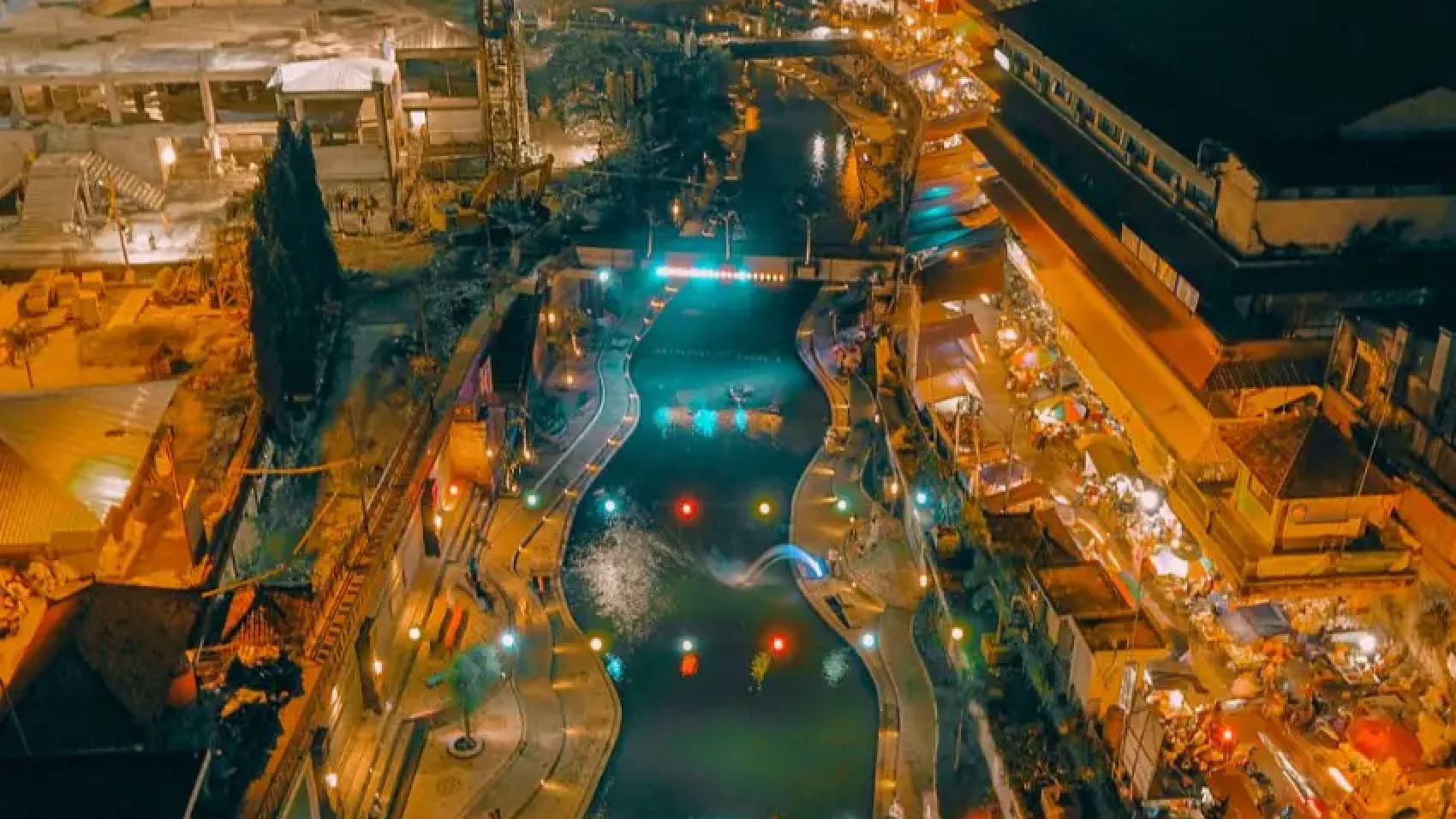
Kumbasari Park, also known as Tukad Korea, is a beautifully designed park located in the heart of Denpasar, Bali. The park mimics Seoul’s Cheonggyecheon river and has become a popular spot for both locals and tourists alike, thanks to its picturesque landscape and unique features.

One of the main attractions of Kumbasari Park is its 548-meter winding river walk. Visitors can stroll along the path and take in the stunning views of the park's colorful seating, neatly arranged stone ornaments, and fountains on both sides of the river. The winding path leads to a floating bridge, which is a perfect spot for taking photographs and enjoying the serene surroundings.

The park's design is inspired by South Korea's beautiful Cheonggyecheon river, and visitors can certainly feel the similarities between the two. Kumbasari Park is meticulously designed, with attention paid to every detail to create a truly immersive experience for those who visit.

The park's seating areas are adorned with colorful cushions, providing a comfortable place to relax and enjoy the view. The stone ornaments add a touch of elegance to the surroundings, while the fountains on both sides of the river create a soothing sound that adds to the overall calming ambiance of the park.

In addition to the winding river walk, Kumbasari Park has several other notable features. The park also has a children's playground, making it an excellent destination for families with young children. There are also several food stalls and vendors selling souvenirs, making it a great place to spend an afternoon with friends or family.

The popularity of Kumbasari Park can be attributed to its unique design, which offers visitors a taste of South Korea's beauty and culture. The park has become a popular destination for tourists looking for an Instagram-worthy photo spot and a peaceful escape from the hustle and bustle of the city.

In conclusion, Kumbasari Park or Tukad Korea, is a must-visit destination for anyone traveling to Bali. The park's winding river walk, floating bridge, colorful seating, neatly arranged stone ornaments, and fountains on both sides provide visitors with a taste of South Korea's beauty and culture, making it an excellent spot for an afternoon stroll or a family day out.

IMG_0758

Big Garden Corner

The popularity of this area, especially among teenagers in Denpasar, Bali, is undeniable. This entertainment area provides a unique backdrop for photos and a cool place to hang out. This recreational area, which opened in June 2016, always presents new creations and innovations so it never gets boring. 

Big Garden Corner is located west of the Padang Galak - Waribang traffic light area, on the Ngurah Rai Bypass, Sanur, East Denpasar. There are various activities that you can do here, such as playing with children, relaxing on bean bags, and taking photos with various objects owned by Big Garden Corner, such as:

"Miniature Borobudur Temple"

This miniature Borobudur temple is 5 meters high and you may have to be patient because there are many visitors who want to take photos here.

"Stone statues with a large number"

In this area, there are stone sculptures ranging from the smallest to the largest sizes. However, most of them are large statues, especially Buddha statues.

Many of the art sculptures and stones there are mostly exported and sold. Therefore, most of the sculptures there look new.

"Colorful umbrella-shaped roof"

The most popular spot for visitors to take cool photos is the path shaded by colorful umbrella-shaped roofs. If you plan to take pre-wedding photos here, there will be a fee of IDR 200,000.

This area can also be used as a venue for wedding receptions that can accommodate 500-1000 people.

"Colorful hangout area"

The spots to relax in this garden are very diverse, especially with the colorful chairs and cushions.

This relaxation area is located in the garden area with large umbrellas and wooden tables.

"Crossing tree trunks"

There are rarely tourist attractions that offer this feature because it is quite expensive and requires intensive care.

"Mini tree house"

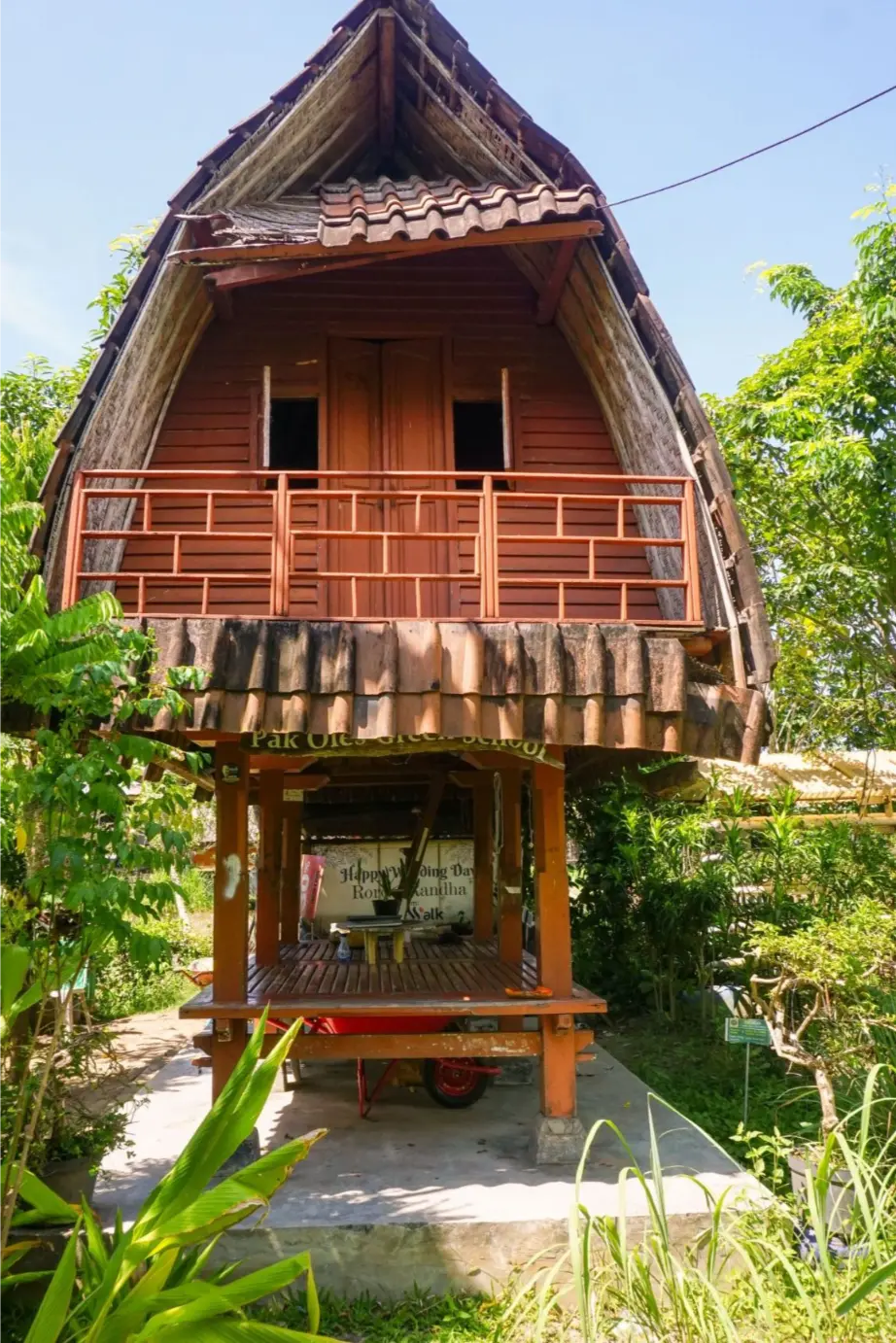
There is a tree house with a thatched roof and wooden structure. Surprisingly, there is a statue of a monkey inside.

Bokashi Farm

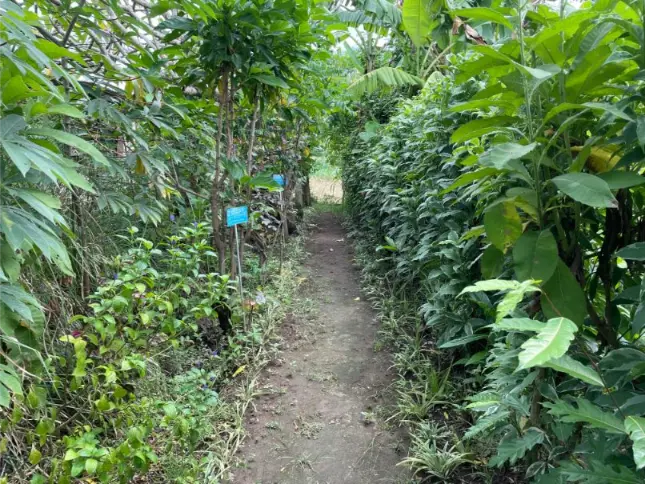
Bokashi Farm, located at Jl. Waribang No.27, Kesiman, East Denpasar Subdistrict, serves as an educational center for medicinal plants and organic farming using EM technology. It offers a green and spacious yard, making it an ideal place for various outdoor activities such as reunions, weddings, birthdays, and meetings. Additionally, the farm features a restaurant in partnership with Warung Sunda "Kang Zanger" that serves halal Sundanese specialties like Nasi Timbel, Gurami, Ayam Bakar, and more, perfect for office lunches, client meetings, or family gatherings.

Bokashi Farm is also a great place for educating people about the benefits of medicinal plants. It receives frequent visits from elementary, high school, college students, and government agencies. With a sprawling area of about 20 acres, visitors can learn about different types of medicinal plants, hydroponics, gardening practices, organic composting, and other outing activities. The farm serves as an integrated farming model and a well-equipped field laboratory.

Moreover, the people of Denpasar are encouraged to recycle their waste using EM technology to produce organic fertilizer, which can be used to enrich gardens, farms, hotel and villa gardens, and especially, the gardens in their respective residential areas.

Citraland Waterpark

Citraland Waterpark Denpasar is an aquatic recreation destination in Denpasar, Bali that features a pirate theme. It is located in the residential area of Citraland on Cargo Permai street, making it a convenient and family-friendly option. The park offers a variety of facilities for tourists, including a spacious parking area, an information center, and ticket counters for the Citraland Water destination. Visitors can also enjoy thrilling water rides, take photos at Instagenic spots, swim in the pool, use the toilets, pray at the mushola, and store their belongings in lockers. The park also has gazebos, seating areas for tourists, and a cafeteria.

For a delightful holiday in Denpasar Bali, explore the best attractions and rides at Citraland Waterpark Denpasar and rejuvenate your body and mind with a refreshing swim in the pool with your loved ones. There are many exciting activities to enjoy, such as the foam pool, race slider, tube slider, adventure gallery rides, lazy river, spilling bucket, and reflection pool.

Dharma Negara Alaya

The Dharma Negara Alaya building was constructed with the aim of inspiring the younger generation to stay creative and innovative. It serves as a venue for exhibitions, cultural-themed events, workshops, and more.

The construction of the Dharma Negara Alaya building is a reflection of the 4.0 digital economy, aligning with Denpasar's vision of being a hub for creativity and culture. Entrance is free, and individuals or groups are welcome to engage in creative pursuits within the building. The DNA building offers various amenities.

If you assume that only art spaces (indoor and outdoor auditoriums) and coworking spaces (both indoor and outdoor) are available, then think again. For book lovers, there is a library with a wide range of books that will pique your curiosity. In case you get hungry or thirsty, you can head over to Mulai Denpasar, a coffee shop that offers affordable food and drinks. It's a perfect place to hang out, right?

WiFi is also available for those who need to look for inspiration or unleash their imagination. Whether you are headed elsewhere or staying within the premises, rest assured that WiFi is accessible. So why not spend some quality time in the creative space provided by DNA?

Duta Orchid Garden

Duta Orchid Garden is more than just a tourist destination. Here the tourist will spend their holiday with such a good experience and get more knowledge especially about orchids and tropical plants in general. Duta Orchid Garden serves the tourist with a good quality garden view as well as a good education or information, especially about plants. During the tour in Duta Orchid Garden the tourist is accompanied by a local guide with a good knowledge who helps to take a picture in a good spot, the guide also explains the way of looking after the orchids in the garden.Treatment the tourist not as a guest, but as a good friend in order to share the correct information about taking care of the orchids and also promoting that Indonesia has many unique rare orchids.

Located in jalan bypass ngurah rai no 21X, Tohpati, Denpasar, Bali, only 15 minutes from Sanur Area. It would provide an opportunity for you to refresh your mind and soul.

The design concept is divided into some parts such as reception, waterfall, shade house, small cafe, souvenir shop, cactus zone, foliage area, fruits garden, orchids, and tropical flowers displayed to provide a sparkling fresh effect in a lush beautiful tropical garden. Huge variety of orchids combine with many kinds of tropical plants . All displayed in the beautiful landscape of a hectare garden.

Embung Sanur

The Sanur Kauh Village area used to be a mangrove forest that had died out and was subsequently turned into a fish pond by the local community. Recently, the area has been transformed into a water storage facility to mitigate flooding.

Embung Sanur was built on a piece of land spanning approximately 2.3 hectares of the Tahura area. It has a pool area measuring 0.96 hectares and a storage capacity of 34,500 square meters. The embankment height from the bottom of the storage is 5.18 meters. This structure is designed to effectively reduce the occurrence of flooding.

Apart from its flood prevention function, Embung Sanur is expected to serve as a recreational, sports, and photography destination for both locals and tourists visiting Denpasar, the capital city of Bali province. 

Sanur is a renowned tourist destination, and the addition of Embung Sanur to its attractions is expected to further boost its appeal.

Taman Jepun

Denpasar, the capital city of Bali province, boasts a tourist destination that serves as a sanctuary for a wide range of frangipani flowers - the Bali Frangipani Palace. Situated on Jl. Hayam Wuruk Tanjung Bungkak, No. 104H, Sumerta Kelod, East Denpasar, this palace is the world's largest frangipani garden.

The palace serves as a conservation site for Indonesia's germplasm, with a particular focus on frangipani flowers. Oka Dipa established this frangipani-based flower garden in 2009 due to his personal preference for this flower. Initially, most of the flower seedlings were grown through his own cultivation efforts. However, the Department of Agriculture later provided assistance, leading to the planting of up to 400 different varieties of frangipani in this 2.5-hectare location.

Of these 400 varieties, 140 originate from Bali while the remaining 260 come from foreign countries, primarily Hawaii and Thailand. The Frangipani Palace houses several interesting features, including the Charles Plumier Monument, which greets visitors as they enter the garden. Plumier, a renowned French botanist, discovered the Frangipani genus named Plumeria. His classification work on over 4,000 plant species led to the identification of 700 new species, including the frangipani.

The palace's vast artificial lake, which lies directly in front of the La Jepun Restaurant, offers a refreshing and picturesque view. Numerous bird species, such as black and white swans, ducks, and other water birds, can be spotted here. Additionally, an international standard gateball field is present. The most recent attraction added to the Frangipani Palace is the pedal go-car game, introduced as one of the garden's recreational options from September 1, 2020.